CLICK HERE FOR THOUSANDS OF FREE BLOGGER TEMPLATES »
Showing posts with label Middle East. Show all posts

Monday, January 21, 2008

Iran, Syria must end interference in Lebanon: Bush

bush


SHARM EL-SHEIKH: US Presidnet, George Bush, has said Syria and Iran must end their "interference" in Lebanese politics, as he ended his Middle East tour.
"It's important to encourage the holding of immediate and unconditional presidential elections according to the Lebanese constitution," Bush said on Wednesday in Egypt's Red Sea resort of Sharm el-Sheikh.
"And to make it clear to Syria, Iran and their allies they must end their interference and efforts to undermine the process," he said.
Bush arrived in Egypt from Saudi Arabia on Wednesday, and headed straight into talks with Hosni Mubarak, the Egyptian president, on a three-hour visit.
In a press conference, Bush said Iraq's government "isn't perfect" but "progress" was being made on political reconciliation.
He called for Arab leaders to get behind Fouad Siniora, Lebanon's prime minister, and said that "nations in the neighbourhood" were willing to help Israelis and Palestinians reach a peace deal.
Mubarak endorsed US hopes for an Israeli-Palestinian peace plan concluding before the end of 2008, and said he will work hand-in-hand with the US and other nations.
Bush urged greater political openness in Egypt, but did not directly criticise the Egyptian government for what the US has previously noted as a lack of political freedoms.
"I'm absolutely confident that people in the Middle East are working on building a society based on justice," Bush said.

Wednesday, January 16, 2008

Strained ties haunt Bush visit to Egypt


080116-bush-egypt-vmed-145a.standard

CAIRO, Egypt - Egypt was meant to be a test case for President Bush's push for greater democracy in the Middle East. But stalled reforms and bitterness over the jailing of hundreds of dissidents are haunting his visit here Wednesday.

Activists say the U.S. democracy push has taken a back seat to politics. They blame Washington for easing its pressure on Egyptian President Hosni Mubarak to win his support on key regional issues such as Iraq and the Israeli-Arab peace process.

At the same time, the Egyptian government has bristled over what it considers American interference, and ties between the longtime allies have cooled.


In a speech on democracy Sunday, Bush made no mention of Egypt except for what was widely seen as an implicit criticism of the country's crackdown on political opponents.

"You cannot build trust when you hold an election where opposition candidates find themselves harassed or in prison," Bush said in the United Arab Emirates. "And you cannot stand up a modern and confident nation when you do not allow people to voice their legitimate criticisms."

Across the Gulf, ruling families have shown little sign of easing their monopoly on power, and Bush was left to praise the few small reforms that have taken place. He pointed to municipal elections in Saudi Arabia, as well as votes in Bahrain, Kuwait and the UAE.

The speech reflected what appears to be warmer U.S. ties with Arab Gulf nations than with Egypt. Notably, Bush spent two days in Saudi Arabia this week, but will stop in Egypt for only several hours to meet Mubarak in the Red Sea resort of Sharm el-Sheik.

Tuesday, January 15, 2008

One reported dead in Beirut blast

BEIRUT: At least one person was reported killed and 10 others injured in a car blast on a seafront road in a northern suburb of Beirut on Tuesday.
"There was a blast inside a car between the Dawra and Qarantina area and we have reports of injuries," a security official, who did not want to be named said while talking to a French news agency.
Local television said one person was killed in the blast along a seafront road, and television pictures showed smoke billowing into the skies over the capital. The cause was not immediately known.
Lebanon has been rocked by a string of bombings, most of which have targeted prominent anti-Syrian politicians.

Rice arrives in Baghdad for talks with Iraqi leaders

BAGHDAD: U.S. Secretary of State Condoleezza Rice has arrived in Baghdad for talks with Prime Minister Nouri al-Maliki.
Rice flew from Riyadh, Saudi Arabia, where she was accompanying President George W. Bush on his Middle East tour. Her trip was announced in the Saudi capital as Bush was holding talks with Saudi officials.
"President Bush and Secretary Rice decided this would be a good opportunity for the secretary to go to Baghdad to meet with Iraqi officials to build on progress made and to encourage additional political reconciliation and legislative action,'' National Security Council spokesman Gordon Johndroe said.
He said Rice, who began talks with al-Maliki in his office, would return to Riyadh Tuesday night.

Fire at Iraq oil refinery injures four

BASRA: A blast at an oil refinery in the Iraqi city of Basra triggered a fire which injured four people on Tuesday, an oil ministry official said, but production was not affected.
The ministry blamed an overflying coalition forces helicopter for igniting gas particles in the air and causing the blast in the southern port city, but the US military denied the claim.
Talking to a French news agency, Spokesman Assim Jihad said that the explosion occurred at a gas production unit at the refinery in Basra, the second biggest city in Iraq whose port handles 80 percent of all the country's oil exports.
The blast sparked a fire which was brought under control within two hours by emergency services at the refinery and civil defence units, Jihad said, adding that four people suffered slight burn injuries.
Oil Minister Hussein Shahristani has blamed an overflying coalition forces helicopter for the explosion, according to Jihad. But US military spokesman Patrick Evans denied the claim by saying, "Our initial reporting indicates that there was a small fire, which has been contained."
"The cause of the fire is currently under investigation, but I can say that the fire was definitely not caused by a coalition overflight."
The ministry has frequently raised the dangers of helicopters overflying oil facilities in the oil-rich Basra region, where many flammable gas particles are in the air, Jihad said.

Syria should use its influence to end Lebanon crisis: Saudi Arab

1-15-2008_35549_l


RIYADH: Saudi Foreign Minister Prince Saud Al-Faisal has urged Syria to convince its Lebanon allies to accept the Arab initiative aimed at settling the presidential crisis.
Al-Faisal, talking to reporters in Riyadh, also expressed the belief that success of the Arab initiative is "still possible."
"Syria is required to convince those who listen to its word in Lebanon of the solution that it had endorsed."
He said "hope persists" that the various factions in Lebanon would approve implementation of the Arab initiative.
"Syria should invest its influence in Lebanon to convince those who listen to its word of the solution adopted by the Arab League."
"Syria is required to invest this influence in the interest of Lebanon's independence and sovereignty."

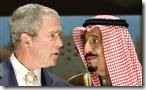
Bush urges OPEC to increase oil output-In Saudi Arabia, president says high prices could cause U.S. slowdown


g-cvr-080115-bush-215a_grid-2x2 “It’s not going to matter to me one way or another,” Bush said. If the Iranians hit a U.S. ship, “there are going to be serious consequences,” he said.

U.S. officials claim Iranian speedboats swarmed three Navy warships in the Strait of Hormuz, the narrow waterway that is the only entry and exit to the Persian Gulf. They said U.S. Navy commanders were considering firing warning shots, before the retreat of the five Iranian speedboats, which the Pentagon said were operated by the elite Revolutionary Guards.

Iran has denied that its boats threatened the U.S. vessels, saying the incident was a normal occurrence, and accused Washington of fabricating video and audio it released. Iran’s government has released its own video, which appeared to be shot from a small boat bobbing at least 100 yards from the American warships.

Pain of rising oil prices
The president spoke to reporters before meeting late Tuesday with Saudi King Abdullah, whose country holds the world’s largest supply of oil. Bush said U.S. consumers are feeling the pain of rising oil prices, which topped $100 a barrel this month.

“When consumers have less purchasing power, it could cause the economy to slow down,” Bush said. “I hope OPEC nations put more supply on the market,” he added. “It would be helpful.”

At the same time, he noted that the higher prices are guided by supply and demand, and that there is little excess capacity in the marketplace.

The Organization of Petroleum Exporting Countries next meets Feb. 1 in Vienna, Austria, to consider increasing output. OPEC oil accounts for about 40 percent of the world’s needs, and OPEC ministers often follow the lead of the Saudis when discussing whether to increase production to take the pressure off rising prices. The Saudis’ views carry great weight because Saudi Arabia is responsible for almost one-third of the cartel’s total output.

Secretary of State Condoleezza Rice, traveling with Bush in the Mideast, slipped away from the Saudi capital at 6:40 a.m. Tuesday for an unscheduled visit to Baghdad for talks with Prime Minister Nouri al-Maliki. Bush said he had been encouraged by signs of progress in Baghdad and decided that she could “help push the momentum by her very presence.”

She congratulated the prime minister, Nouri al-Maliki, on the passage of legislation reinstating former Saddam Hussein loyalists to government jobs and pushing for progress on other benchmark laws. At a Baghdad news conference, she said political progress has moved along “quite remarkably,” citing a new law that allows thousands of former members of Saddam Hussein’s Baath party to reclaim government jobs or pensions.

Rice added that the Iraqi parliament’s approval of that U.S.-sought law Saturday was a first step and showed that last year’s increase of U.S. troops in the country was paying dividends.

Bush said he would not go to Iraq while traveling in the region. There had been widespread speculation he would make a visit.

Focus on Israeli-Palestinian peace process
One of the primary objectives of trip is to build support for the Israeli-Palestinian peace process. He said that Abdullah asked him why he was optimistic about securing an agreement before his White House term ends in January 2009.

“Part of my mission was to make clear why talks failed in the past. There wasn’t participation by the neighbors,” Bush said, referring to Arab countries that have kept an arm’s length from the negotiations.

Bush said he was convinced that the Arab leaders want to see the creation of a Palestinian state in a peace agreement with Israel. “They definitely want it to happen,” he said, “and they questioned the seriousness of the United States to remain involved in what has been a long and frustrating process.”

“They want to see a deal done,” he said. “The issue frustrates them.”

Bush spoke to the group of reporters while sitting in a chair under a gold and crystal chandelier in an ornate room of the kingdom’s guest palace. Bush said he has faced persistent questions during his trip about a new U.S. intelligence estimate that said Iran had abandoned its nuclear weapons program in 2003. That conclusion contradicted Bush’s claim that Iran was pursuing nuclear weapons and raised questions in the Mideast about U.S. intentions toward Iran.

The president said he made clear that the new finding was a judgment by independent intelligence agencies and that “all options are on the table for dealing with Iran.” At the same time, he said he has told leaders he wants a diplomatic solution.

Tensions flared anew with the confrontation last week in the Gulf. Bush said it would be up to the captains of the American ships to determine if their vessels are in jeopardy from Iranian boats.

“These are judgment calls and there are clear rules of engagement,” he said. Still, he told the Iranians: “They better be careful. If they hit one of our ships there are going to be serious consequences.”

RIYADH, Saudi Arabia - President Bush urged OPEC nations on Tuesday to put more oil on the world market and warned that soaring prices could cause an economic slowdown in the United States.

“High energy prices can damage consuming economies,” the president told a small group of reporters traveling with him in the Mideast.

In a stern warning to Iran days after a Jan. 6 confrontation with U.S. warships in the Persian Gulf, Bush put Tehran on notice that it needs to be careful. The president said it would not matter to him whether an attack against an American vessel resulted from an order by the government in Iran or a rash decision by an Iranian boat captain.