CLICK HERE FOR THOUSANDS OF FREE BLOGGER TEMPLATES »
Showing posts with label CHINA. Show all posts

Tuesday, April 1, 2008

China warns Japan, Europe not to support Dalai Lama

BEIJING  ( 2008-04-01 20:37:00 ) : 

China said on Tuesday it opposed foreign nations providing support to what it said was the Dalai Lama's attempts to split Tibet from China, reacting to reports that he may go to Japan and Europe.
"We oppose his split’s activities. We oppose any officials of foreign countries providing support for the split’s activities by the Dalai Lama," foreign ministry spokeswoman Jiang Yu told reporters.
Jiang made the remark when asked to comment on plans by the Dalai Lama to make a stopover in Japan next week on his way to the United States.
The Dalai Lama is a frequent visitor to Japan, where he enjoys a wide public following. But unlike many of their Western counterparts, Japanese leaders have almost always refused to meet the Nobel peace laureate.
French Foreign Minister Bernard Kouchner also said on Tuesday the European Union's 27 foreign ministers would invite the Dalai Lama for talks in Brussels.
"As the Dalai Lama does not ask for a boycott (of the Olympic Games in Beijing) nor Tibet's independence it is time to go back (to dialogue)," Kouchner said.
When asked to comment on this, Jiang referred to her previous statement.
The Dalai Lama has repeatedly denied he wants independence for Tibet, or is trying to orchestrate independence. He has said he wants greater autonomy for Tibet under Chinese rule, but also an end to repression there.

Friday, March 28, 2008

China takes foreign diplomats to Lhasa

BEIJING  ( 2008-03-28 09:58:01 ) : 

A group of Beijing-based foreign diplomats were scheduled to leave for Tibet's riot-hit capital Lhasa on Friday for a two-day trip organised by the Chinese government, embassy officials said.
Diplomats from a number of countries including the United States, Britain, France, Australia and Italy were to participate in the trip, which came on the heels of another government-arranged tour for foreign journalists.
"I suppose the objective of the Chinese foreign ministry is to basically answer the international calls including from the Australian government to have diplomatic access to Tibet," said Janaline Oh, an Australian embassy official.
She said embassies in Beijing were only informed about the planned trip on Thursday, while an Italian embassy spokeswoman said the representatives were expected back on Saturday night.
One diplomat said that the embassies had been allowed to send one official each, although there was no official comment on the trip from Beijing and it was not clear how many countries were going or had been invited.
In Washington, State Department spokesman Sean McCormack welcomed the move, but said it was not enough.
"We see this as a step in the right direction, but it's not a substitute for the ability of our diplomats, as well as others, to travel not only to Lhasa, but into the surrounding area specifically," he told reporters.
China took a foreign media delegation to Lhasa on Wednesday for a three-day trip following international pressure to allow independent reporting from the Tibetan capital after it was sealed off due to the unrest.
AFP and some other major news organisations were not invited.
Two weeks of deadly demonstrations against China's rule of Tibet have put China under international pressure as it prepares to host the Olympics in August.
China has insisted its response to the protests, the biggest challenge to its rule of Tibet in decades, has been restrained and that it has brought the situation under control.

Dalai Lama appeals for talks with Beijing

NEW DELHI: The Dalai Lama appealed to China Friday to enter into "meaningful dialogue" over the crisis in Tibet, asserting he did not want to undermine the Beijing Olympics and was not seeking independence.
In an open letter to his "Chinese brothers and sisters," the exiled spiritual leader said he was a "simple monk" trying to preserve "the Tibetan people's distinctive culture, language and identity."
He warned, however, that Chinese "state media's portrayal of the recent events in Tibet, using deceit and distorted images, could sow the seeds of racial tension with unpredictable long-term consequences."
"Even at this juncture I have expressed my willingness to the Chinese authorities to work together to bring about peace and stability," he said in the statement, carried by his exiled administration's website Tibet.net.
"I have appealed to the leadership of the PRC (People's Republic of China) to clearly understand my position and work to resolve these problems. I urge the Chinese leadership to exercise wisdom and to initiate a meaningful dialogue with the Tibetan people," the message said.

Thursday, March 27, 2008

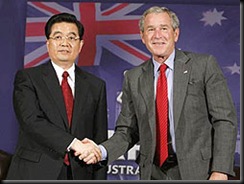
Bush, Hu press North Korea over nuclear arms declaration


98777_news_image

WASHINGTON  ( 2008-03-27 11:13:44 ) : 

US President George W. Bush and his Chinese counterpart Hu Jintao pressed North Korea on Wednesday to come clean over its nuclear arms program, as South Korea warned that time and patience were wearing out on Pyongyang.
In a day of intensive diplomacy, the White House said Bush telephoned Hu to help get North Korea to make a full declaration of its nuclear arms program, while Secretary of State Condoleezza Rice met with her South Korean counterpart to keep up the heat on the Stalinist state.
"The two presidents pledged to continue to work closely with the other six-party partners in urging North Korea to deliver a complete and correct declaration of all its nuclear weapons programs, and nuclear proliferation activities and to complete the agreed disablement," a statement said.
"Bush expressed appreciation to President Hu for the important role China has played within" the six-party talks, which it chairs and are aimed at ending North Korea's nuclear weapons drive, added the statement. North Korea has refused to make a "complete and correct" declaration of its nuclear weapons program and alleged proliferation activities as part of an aid-for-disarmament deal agreed to by the six parties -- the United States, China, the two Koreas, Japan and Russia.
"It's time to bring this to a conclusion," Bush's National Security Advisor Stephen Hadley said of the ongoing effort by the parties to get North Korea to come forward with a full declaration. "This has been going on for a while."
The declaration was supposed to havtion to Syria.
"It was time, I think, for the president to signal to Hu Jintao that it's time for all of the parties of the six-party talks, including China, to re-engage with North Korea," Hadley told reporters.
Rice said Pyongyang's reluctance to provide the declaration was holding up the six-party talks, which had to lay the groundwork for North Korea to dismantle its nuclear arsenal -- the final phase of its denuclearization effort which Washington wants concluded before Bush retires in January 2009.
"It is really time now for there to be movement on the declaration so that with that declaration we have, we can move forward on the next phase," Rice told reporters after talks with South Korean foreign minister with Yu Myung-Hwan.
Yu said, "I think time and patience is running out.
"I hope North Korea will submit the declaration as soon as possible so as not to lose good timing," he said.
Rice said the declaration and any associated documents should show the full range of the North Korean nuclear programs and activities "so that there can be an effort to verify and to deal with anything that has happened concerning North Korean programs and proliferation and the like.
"We've been concerned about North Korean proliferation for quite a long time. The six-party framework should be able to deal with this problem or these problems so that we can stay on course to the denuclearization of the Korean peninsula," she said.

Wednesday, March 26, 2008

China tries to isolate Dalai Lama, speaks out against France trip


98677_news_image

BEIJING  ( 2008-03-26 15:01:04 ) : 

China stepped up pressure to isolate the Dalai Lama on Wednesday, opposing talks between the Tibetan spiritual leader and French officials during his proposed trip to France in August.
China's foreign ministry said it was firmly against meetings between the Dalai Lama, whom it blames for recent deadly unrest in Tibet, and officials from any other country.
"The Chinese government resolutely opposes official contact of any kind between any country and the Dalai Lama," said foreign ministry spokesman Qin Gang.
"China resolutely opposes the Dalai Lama going to any other countries in any capacity to promote his separatism from China."
Qin was responding to a question about the Dalai Lama's proposed trip to France in August and possible meetings with French officials, including President Nicolas Sarkozy.
China has already this week denounced US House speaker Nancy Pelosi for meeting with the Dalai Lama, and last week spoke out against a plan by British Prime Minister Gordon Brown to meet him in May.
A Tibetan spokesman said on Tuesday that the Dalai Lama would visit France in August. Beijing is playing host to the Olympic Games from August 8 to 24.
French Foreign Minister Bernard Kouchner, in an interview published Wednesday, recommended that Sarkozy meet with the Dalai Lama during the trip.
France's junior minister for human rights, Rama Yade, said she intended to meet with the Tibetan Buddhist leader.
China has branded the Dalai Lama a separatist and said he masterminded this month's unrest in the Himalayan region which has left at least 140 dead, according to Tibetan exile groups. China has put the toll at 20.
Kouchner said the ordinary people of Tibet had a different view of the Dalai Lama than the Chinese government.
"For the people he is a religious leader, a guide to the Tibetan people. I think one should meet with him ... but it is not me who decides," Kouchner told the daily Le Parisien.
Sarkozy has spoken out against the crackdown in Tibet and said on Tuesday a boycott of the Beijing Olympics opening ceremony was possible.
The Dalai Lama, who won the 1989 Nobel Peace Prize, has repeatedly denied Chinese charges that he has orchestrated the recent unrest and that he wants independence for his homeland.
He has said only wants greater autonomy under Chinese rule for Tibet, and for an end to the repression there.
The Dalai Lama fled Tibet in 1959 following a failed uprising against Chinese rule, which officially began eight years earlier.

Tuesday, January 15, 2008

Indian PM proposes nuclear energy cooperation with China

BEIJING: With a controversial nuclear deal with the United States now in limbo, India held out the possibility Tuesday of civilian nuclear cooperation with China.
Indian Prime Minister Manmohan Singh, on the last day of a visit to China, said the world's two most populous nations who have a decades long history of mistrust should work together to develop their nuclear energy programmes.
"India seeks international cooperation in the field of civilian nuclear energy, including with China," Singh said, noting such cooperation could help the two countries meet their skyrocketing energy needs.
"The rapid growth of India and China will lead to expanding demand for energy. We have no choice but to widen our options for energy availability and develop viable strategies for energy security," he said in a speech at the Chinese Academy of Social Sciences.
He did not go into further details.

Monday, January 14, 2008

India and China pledge to strengthen trade, military ties

BEIJING: China and India pledged Monday to strengthen trade and military links and seek a solution to a border row, as India's prime minister sought to cement a rapid improvement in ties with a landmark visit.
The friendly atmosphere was tempered, however, by Prime Minister Manmohan Singh's call for China to make concessions to reduce a growing two-way trade imbalance.
The Indian leader said he and his host Premier Wen Jiabao signed a broad agreement to push an often testy relationship to a new level of cooperation.
The pact lifts the target for bilateral trade -- which soared to 38.7 billion dollars last year -- to 60 billion dollars by 2010, and pledges a renewed effort to solve a Himalayan border dispute.
It also commits the two sides to another joint military exercise this year, following their first-ever exercise late last year, and to pursue a possible regional trade agreement, said Singh, who arrived on Sunday.
Singh called the document "an important milestone in the evolution of our relations." "The profound changes taking place in the world today present both our countries with a historic opportunity to work together towards a 21st century that is conducive to peace and development," he told reporters.
"It reflects not only our common perceptions but also our desire to purposefully cooperate in the future."